René Lévesque, who was a reporter for Radio-Canada long before he became an irritating (although honest) politician, once wrote that there is nothing deader than old news. I am therefore going to apologize in advance for a huge bit of old news: namely, the story of our trip to Florida in March.
I have purposefully emphasized the travelling-to-Florida portion of it, because it was so unusual. This tract was written with reference to notes I kept during the trip, and I have chipped away at it as time has allowed over the last three months.
To further paraphrase Mr. Lévesque, here is what should have been a red-hot news story transformed into a documentary, served up cold. What can I do? If I were retired I could have had this out within a week. Work just so totally interferes with life, doesn't it?
------
FRIDAY, MARCH 7
So we wake up at an unholy hour of the night to get started, see. When making the 10-hour drive to Manchester, New Hampshire, an early start is key to the whole thing. You mess that up, and you're done. It's like using a match to see if you still have gas in your tank. Okay, it's not really like that. Let's move on.
Therefore the kiddies were dragged out of bed at an hour only slightly less painful than their parents' wake-up time, and by about 5:00 a.m. we were underway.
Now, I am not normally one who enjoys a Point-A-to-Point-B drive. Goodness knows I love to dawdle and make frequent stops, if I can. But that's not so easy with my family in the car, as eventually everyone gets tired of being on the road. So on this particular day, I decided we would make tracks. And once the sun came up, it was a bright, beautiful day.
 After about four hours on the road, we arrived at the US border, via PEI Routes 11, 1A, and 1, then New Brunswick Routes 16, 15, 2 and 1. This brought us to St. Stephen, New Brunswick, from where we crossed into Calais, Maine. I must say that I certainly get less hassle from customs and immigration agents when I'm travelling with my family than if I'm by myself. In no time we were cleared to continue and we headed a short distance up US highway 1 to take the formerly infamous Airline Route - Maine state highway 9 - to Bangor/Brewer. This road - about 85 miles from Calais to Brewer - used to follow the exact contour of the land: up, down, up, down, zig, zag, left, right, etc., etc. And let's just say it was never in the best of shape, and didn't leave one much room if one had to stop at the side of the road. A few years ago, though, the state upgraded the road, levelling, straightening and widening it. It's still a scenic drive, but without the motion sickness.

 What is it about the state of Maine that they have picture-perfect days whenever I travel there? Just north of Calais (instead of just inside the border, where one might expect such a thing) is one of Maine's big blue signs welcoming touristas like us: MAINE. The way life should be. No kidding. Nearly no traffic, blue sky, sunshine, snow still on the ground but none on the road, and hills, mountains, rivers, trees... The way life should be, indeed.
 Around 10:30 a.m., we reached Bangor and got on Interstate 95 southbound. We still had made no stops - not even a bathroom break for the kids, which has to be some sort of record.
At Augusta, it was time to stop and purchase some petrol. We found a station with a convenience store, and everyone took turns visiting the washroom. I was last, and as I was leaving I noticed two women waiting for the washroom. One of them - I am not making this up - had a mischevious grin, and as I cruised up to the counter to pay for my $57 fill-up, both women went into the washroom. The proprietor, who looked to be Middle Eastern, suddenly bolted from behind the counter and raced to the now-locked washroom door. "Not the both in the bathroom!" he stammered in Arabic-accented English, as he knocked furiously. "Not the both in the bathroom!! Only one!!" He came back to the counter, flummoxed and shaking his head in disgust. I paid him and left, and it was all I could do to keep a straight face until I got out of the store. By the time I got back to the car, where Marie and the young'uns were waiting, I was laughing quite hard. I recounted the story to everyone, and there were more laughs all around.
All I can say to this guy is: Dude! Welcome to America. If you're not prepared to put up with some lesbian action in the washroom of your store, maybe this isn't the place for you.
At Portland, where we planned to stop to eat, we found all four of the children asleep. They had fought it as long as they could (with the exception of Camille, who never objects to napping in the car), and now they were out solid. So we pressed on, through Portland on I-295, then back onto the 95 toward Portsmouth.  I resisted the temptation to wake Paul when we crossed the Piscataqua River Bridge, leaving Maine to enter New Hampshire. Paul loves bridges - especially large iron bridges -
but the thrill he would get from seeing the bridge once again was outweighed by my desire to have the final 40 minutes to Manchester on NH Route 101 pass as peacefully as possible. Which it did.
We stayed at a different hotel in Manchester this time, having previously tried the Wayfarer Inn in 2006 and 2007, and the Executive Court Inn back in 2000. The 2008 winner of Meets Ig's Infamous Standards of Parsimony Award was the Sleep Inn, near Exit 5 off I-93. While it's not the fanciest place around, I was impressed by the service offered by the staff at the front desk. More on that later.
La familia Cerdo is not one that spends a lot of time shopping, for the sake of shopping. (Cf. earlier comment about "parsimony".) But for some reason, since we had a lot of time on our hands (we arrived at the hotel before 2 p.m., approximately 27 hours before our scheduled flight to Newark. The Mall of New Hampshire drew us for a visit, and for the second year in a row, we were amazed at the cars and people entering and exiting the place. There were so many people at the mall, in fact, that I felt somewhat uncomfortable. As I get older, one of the things I have discovered about myself is that I dislike crowds. The place could have been in Toronto a week before Christmas if the crowds were any measure, not a smaller city like Manchester. (Although I have no doubt that the place draws from a region larger than just the city of Manchester.) After finding a couple of bargains at Sears, and indulging Charlotte's insistent wish to visit the pet shop (imagine Bart and Lisa Simpson badgering their parents with "Will you take us to Duff Gardens?", but change the question to "Est-ce qu'on peut aller à l'animalerie?", and you more or less have the scene accurately pictured), we made our way out to find a place to eat.
 I have yet to have a good meal in a restaurant in Manchester. This should not reflect badly on the city, as it is actually the fault of Ig and his spouse. In 2007, we stopped in to Pizza Hut for a "meal", and while the food was good, the issue was that we simply didn't order enough of it. Even Paul, I recall, demanded the right to raid the salad bar after he had inhaled a large amount of pizza. On this trip in 2008, we got hooked on the idea of going to a buffet, the key words here being "all you can eat", so as to sate the children sufficiently for the rest of the day. So we chose Chinese, and visited the New Yee Dynasty Restaurant. Not much to add to this story but a bit of advice: AVOID, AVOID, AVOID, AVOID, AVOID! Check the ratings on the page I just linked to - apparently I am not the only one who suffered the terrible food and lousy service here. But I'll accept the blame for it, as it was a case of insufficient research. Next time, we'll go back to Pizza Hut, and I'll open the damn wallet wider. (Cf. earlier comment about "parsimony".)
Anyway, back at the Sleep Inn, we had a raucous and thoroughly enjoyable swim in the hotel's indoor pool, and then turned in for the night. Tomorrow would be a full and busy day, and we had to be ready.
-------
SATURDAY, MARCH 8
I had turned in to bed on Friday night with a lingering worry about the weather. Just two or three days earlier, a significant snowfall had passed through New England on its way to Atlantic Canada. This followed a pattern of a generally rough winter, with lots of snowfalls and unstable weather. Flights had been cancelled numerous times in the preceding days and weeks because of the weather. So I got up early and headed to the computer terminal in the hotel lobby to check the weather, and the status of our flight. The forecast for the afternoon was rain, heavy in the mid-afternoon, then tapering off a little into the evening. Not so bad, I thought. The flight was checked, and I was relieved to see "ON SCHEDULE" as the reported status. It was 7:00 a.m. So far, so good.
We advised the front desk that we would need to leave the hotel on the park-and-fly shuttle around 3:00 p.m. No problem, all set. After an breakfast of energy bars and juice, and some relaxation time in front of the TV, we headed back to the pool for a swim. And that's when things started going downhill.
The pool was closed for the morning so it could get its scheduled treatment of chlorine. The kiddies expressed disappointment, and then began calling for some sort of outing to pass the time. While we pondered the possibility of doing something, I returned to the lobby to check our flight status again. It was now 11:00 a.m. The computer ground and cycled dutifully for several moments after I punched in my flight number, and then showed me the flight status.
 "CANCELLED." Nothing more to see here, folks. Move along. Your flight is cancelled.
I'm not sure what I actually said to myself when I had absorbed this elephant-sized wrinkle in our plans, but I think it was something like, "Shheyyyaaaaaaattt!"
The next step was to find Marie and inform her of this development. Then we returned to the computer and started digging around, trying to rationalize what had happened. Everything outdoors in southern New Hampshire looked fine, but apparently Newark was experiencing high winds, preventing some smaller planes from departing to places like Manchester. What was more, there were fewer planes available in Newark anyway due to a previous storm delay on Thursday, when several flights from the midwest were cancelled. A bad case of dominoes.
Then I got on the telephone to try to get through to Continental Airlines, which quickly acquired a new epithet, namely InContinent Airlines. Did I mention I couldn't get the telephones in our hotel room to work? I borrowed the telephone at the front desk, and once the call was answered by the automated service and put in a queue, the desk clerk, Kathy, forwarded the call to another telephone in the lobby that was a little more private and closer to the computer. After waiting about 15 to 20 minutes, my call was answered by an actual human being.
Normally such a development is good news. But notice that I referred to the customer service dude at InContinent Airlines as a "human being", not a "live person". Human being was technically accurate, but except for the fact that dude was at work and (I assume) breathing, there was nothing "live" about him. He sounded as if he had not slept in a week, and could not raise his voice above the common call-centre setting known as "Pathetic Moan". I forget his name, but we'll just call him "Dude". After getting my reservation number (WAITER: "Do you have reservations?" IG: "Yes, but when you're as hungry as I am, you throw caution to the wind."), Dude informed me that an e-mail had in fact been sent to me informing me of the flight cancellation and providing me with my new itinerary.
"That's terrific," I replied. "The e-mail would have been sent to my home."
"Yes," sang Dude charismatically.
"I'm 600 miles from home right now. You're going to have to give me the information over the telephone."
"Okay." Pause.
"Um, you can go ahead."
"Well." Dude paused to catch his breath. "We have you booked to leave Manchester on Monday morning, March 10th---"
"TWO DAYS FROM NOW?" I sputtered. What I wanted to say was, "My ass, my ass, my ass, my ass, my ass," but Marie was nearby, as were other hotel guests and Kathy the desk clerk, and the little bit of decorum I still have overrode my initial, but likely more appropriate, response. "Never, never, never, no way. You must have something else. It doesn't have to be out of Manchester. We can get to Boston. Please check. And we don't have to fly through Newark. We're fine with a direct flight to Tampa." I guess that last part probably went without saying, but I didn't think I should skip anything while dealing with Dude.
"Hold, please."
[Insert five minutes of annoying music and obsequious but mendacious recorded fatuities from InContinent Airlines here.]
"Sir, I have nothing leaving Manchester or Boston this afternoon."
"Did you check with any other airlines? I flew on Delta once, and the plane didn't crash. I'm open to trying them again. And eight years ago, when Continental's plane blew a tire in Manchester and cancelled my flight, we got new seats with US Airways."
"There is nothing this afternoon, sir." Dude sounded like he could have gone on like this the rest of the afternoon, though.
Uh huh. As if you checked, Dude. "What about tomorrow morning?"
"Hold, please."
Another five minutes passed. Same music, same bullshit about my call being the most important call ever taken by anyone anywhere.
"Okay sir. I have you rebooked."
Pause.
"Um, you can go ahead, please."
"I have you booked tomorrow morning, all six in your party, departing Boston at 9:30 a.m. to Newark, then Newark to Tampa, arriving 5:30 p.m." This was momentous, as I expect Dude had never before strung together such a lengthy and detailed sentence. I glazed over what was obviously going to be a long layover in Jersey, and asked Dude for a confirmation number.
"It's the same one you already have, sir."
"Fine. Thank you. Now, we are presently in Manchester, and to travel to Boston, we have to arrange for ground transportation. Who is going to cover the cost of this?" I asked directly. (Cf. earlier comment about "parsimony".)
"I cannot talk to you about that, sir. You'd have to speak with Customer Care." Dude did not work in Customer Care. He worked in Customer Service. Surely I should have been able to understand the difference.
"I see. I assume, therefore, that to see about having a second night at this hotel covered, I would need to speak with Customer Care?" I knew this was going nowhere, and even if Dude had been authorized to talk about such things, I figured there was no possibility of the airline covering the hotel bill since the delay was weather-related, not technical (read: equipment failure or caused by incompetence). But the incompetence seemed to be swirling just below the surface anyway, and I felt the need to vent about the situation, so I asked the questions.
"Correct, sir. Could you hold a minute?" asked Dude innocuously.
"Um, sure." I figured Dude was working on something, or needed to ask a question of a coworker, and needed a minute. The music restarted.
It lasted about fifteen minutes this time.
"What's going on?" asked Marie.
"Not sure. He asked me to hold. I'm holding. Don't understand it."
Finally the music stopped and the call seemed to be transferred. I heard ringing, and finally a woman answered. Unlike Dude, she seemed to speak English well and had a personality. We'll call her Wendy. I explained what I had been on the telephone for, and that I had been asked to hold, and I wasn't sure why.
"Oh," said Wendy. "Funny. This is an internal line. No one should have transferred your call here. But is there anything I can help you with?"
"Indeed there is," I said. "Could you please confirm what Dude just told me? Are we really re-booked for tomorrow morning out of Boston?"
"Yes, it's all here," she said, after getting the immortal confirmation number. I asked about the hotel and the ground transportation. I felt I had no case for the hotel, since it was the start of our trip, not a layover, and no one had forced us to drive 600 miles from home to travel from this particular airport. But getting us from Manchester to Boston was going to be either complicated or expensive, or both, and I thought I had a reasonable request. Wendy mulled it over for a bit but said she really couldn't help with either item. After all, we had originally been re-booked out of Manchester two days hence - had we taken it, there would be no need for ground transportation to Logan.
I didn't mind all that much when Wendy said no. If she had said "Look after your own goddam ground transportation to Logan," I doubt I would have been offended. It was a relief just to talk to someone who sounded like she knew what she was doing, and who answered my questions with some authority. Take note, airlines: this is what we like dealing with when things are running smoothly, and when things aren't. Hire people who can actually communicate on the telephone, and who sound like they are taking you seriously, and who aren't addicted to valium. It ain't rocket science. I know good help is hard to find, but really. Try a little harder. You don't have to kiss my ass, you just have to sound alert and be reasonably competent. And don't transfer my call into the ether for no apparent reason.
Well, enough of all that. No one listens anyway. The important thing at the time: one call was done.
My next call was to Thrifty Rent-a-Car. They need a nickname, too, so we're going to call them SpendThrifty, the reasons for which will become apparent later. Again the call was placed from the front desk, and again Kathy was kind enough to bounce the call over to the telephone located next to the comfy lobby sofa. After a short wait, my call was answered by a live person, a woman with a sympathetic telephone manner and a Filipino accent. We'll call her Imelda. No, no, no, sorry. That was totally inappropriate. We'll call her Martina. In fact, if memory serves, this may have been her real name anyway.
I explained to Martina that we had been scheduled to fly into Tampa this evening - i.e., Saturday evening, arriving around 11 p.m. - but that we were delayed, and instead we would be arriving the following day, Sunday, around 5:30 or 6:00 p.m. Could she please note the change and hold our rental vehicle until such time as we arrived?
"Could I have your confirmation number, sir?"
After my experience with InContinent Airlines, I had this bit of information ready. "Certainly. It's Delta, Charlie, Tango, zero, six, four, six."
Martina typed this into her system, and waited a minute. "Mr. Pig, is it?"
"Right."
"Yes, I have your reservation here. You're scheduled to pick up the car tonight in Tampa after 10:00 p.m."
Blink. Um, yeah... I thought I had just said that. "Correct. But as I explained, we are delayed until tomorrow. We would like to pick up the car tomorrow instead, around 6:00 p.m."
"Hold, please." Uh oh. How long is this going to take? My initial worry was unfounded, though, as Martina quickly came back on the line. "Mr. Pig, I've checked with our location at Tampa International Airport. Unfortunately there are no minivans available tomorrow."
It took me less than a half-second to realize that this call was deteriorating rapidly into territory in which I had hoped not to tread. "But, ma'am, we have a minivan booked for pick-up at Tampa Airport this evening. Surely it will still be there tomorrow if we don't pick it up tonight. I'm just asking you to make this change to our itinerary. I'm not asking to pay for one less day of rental. Just hold the car there."
"Hold, please." This time there was a bit of music to calm my frayed nerves. Then Martina came back. "I'm sorry, sir, but I've checked again. There are no minivans available at Tampa Airport tomorrow."
The call-centre settings used by Martina were obviously "Well Mannered" and "Very Stupid". I could feel my temperature rising but I kept things together. "Look," I implored, "it's all very simple. Across the street from the main terminal at Tampa Airport is a parking garage full of rental cars. A bunch of these cars are rented out by SpendThrifty. One of SpendThrifty's cars sitting in that garage right now is a minivan for which I have a confirmed reservation, and which I was scheduled to pick up tonight. Just leave that very same minivan where it is for another day. Don't touch it; don't move it. Don't rent it to anyone else. We'll be arriving tomorrow, and we'll pick it up then. Okay?" Surely, she would see what to do this time.
"Hold, please."
"Thank you."
A minute passed. "Mr. Pig, I apologize, but I have checked again, and there are no minivans available at Tampa Airport on Sunday. If you like, we can rent you an eight-passenger minibus--"
"Which gets 1.3 miles to the gallon and costs three times as much to rent!" I interrupted. "Not a chance! I want my minivan. This problem has a very simple solution, one rooted in common sense, and for some reason you seem not to know what to do." I tried to avoid spitting or spewing as I spoke, but it was difficult. "Please connect me with your supervisor or manager."
"Well, sir, I do apologize, but there are no minivans available tomorrow in Tampa. And the supervisors are busy. You may be in for a long wait."
"Not a problem, Martina, I've got all day. Put me on hold if you like, and I shall wait for a supervisor."
"Yes, sir." The music started again. After about 45 seconds Martina was back on the line. "Sir, the supervisors are taking calls from other customers. And while I had you on hold, I checked Tampa Airport again. There are no minivans available on Sunday afternoon. I do apologize. Perhaps you would like to call back later, and speak to a supervisor then."
"Not a chance, Martina. If I do that I could end up in your call queue for an hour or more, if things get backed up. I'll hold."
"Yes, sir." The music started again.
During this time, Marie was staring at me incredulously. Kathy, at the front desk, having seen me pace with the telephone in my hand and having overheard the greater portion of the call, was smiling and shaking her head in disbelief. I assure you I too felt as if the whole thing were surreal. I tried to find the humour in the situation and forced a smile and chuckle. The head shaking by now had become involuntary.
After ten or so minutes of waiting, interrupted by Martina's apologies and useless suggestions, another woman came on the line. Her name was Kim. She sounded like she could have been African-American, and she identified herself as a supervisor. Like Wendy at InContinent, her manner was confident, professional, friendly and direct. I explained the situation all over again, as I was not confident Martina could tell the tale without making it sound like I was trying to order 19th century plumbing and electrical supplies from Ulan Bator.
"Hold, please," ordered Kim.
"Thank you."
About thirty seconds passed, then Kim came back on the line. "Okay, sir, I've made the change for you. Your minivan will be available when you arrive in Tampa tomorrow afternoon. You're using the same reservation number." (Of course!)
I thanked her and hung up. I looked Marie and Kathy, who were laughing by now. "Kim was able to fix it," I reported sweetly. Two calls were done. Now we just had to figure out how we were going to get to Logan airport the following morning.
While I had been on the telephone, Kathy had found some information on ground transportation into Boston, and Marie had obtained information on Beantown's subway system. We had the following options:
- Hire a van to take us from the front door of the hotel to Logan Airport. Price: $99.
- Take the free shuttle from the hotel to Manchester Airport (we paid for park-and-fly, so it's technically not free, but you get the idea), then take the Boston-Manchester shuttle into the city of Boston (free to anyone who can show an itinerary or boarding pass that proves flight into or out of Manchester), then find our way to Logan via taxi or public transit. Price: Just the public transit.
- Hitch-hike starting at 5:00 a.m the next day and hope for the best. Price: Undetermined.
After careful consideration lasting about two seconds, we chose the second option. (Cf. previous comment about "parsimony".) The Manchester shuttle runs 24 hours a day, seven days a week, and the schedule that Kathy found in a brochure showed departures from Manchester Airport every two hours on the even-numbered hours. Sweet. We would aim for the 6:00 a.m. shuttle, which would leave a sensible amount of time to get into Boston and then we would make our way to Logan via the subway. Things had gone off track, obviously, but we had done what we needed to do. (Post-script: I note, with much sadness, that the free Manchester-Boston shuttle shall cease operations on June 30th, 2008.)
With our calls done and our new plans made, we headed outside to the car. It was pouring rain, which added to the disappointment we felt at not being able to fly to Florida as planned that day. The four piglets were especially downcast, although they came around pretty quickly, all things considered. We drove back to the Mall of New Hampshire, which seemed like a good idea when we were still at the hotel, but less so once we arrived. The place was jammed full even worse than the previous day. It was a rainy Saturday in March. What did we expect all 13,922,517 residents of New England to do? Clearly we should have anticipated seeing all of them at the mall. Mercifully, we didn't stay long, and decided to try to find a church. Maybe one would have Mass at 7:00 p.m. or something.
We drove about in the rain, and soon realized we would either have to find a telephone book or ask someone local. So we stopped at The Distinguishing Touch Florist on Mammoth Road, and I stumbled inside, dripping wet, to ask about a church. "Why yes," said the owners, "there's St. Jude's nearby, and Mass is at 4:00. We're heading there ourselves." They were kind enough to give us directions and even provided a map of the local area. I was so impressed by their friendliness that I hereby vow to give them all of my floral-related business the next time I am in New Hampshire. Seriously, though: great people. Encounters with people like these are further proof that Americans are the friendliest, most outgoing people on Earth.
As we exited Mass around 5:00 p.m., I noted to myself that the name of the church was appropriate. St. Jude is the patron saint of lost causes. Perhaps we would, eventually, make it to Florida.
Dinner was ordered in, and it was wicked good. I have never had a steak bomb pizza before, but wow. Excellent! Chock full of calories and cholesterol. Everyone at like kings. It made up for the Chinese "food" from the previous day.
The pool had by now reopened, and we returned to take over the place for a spell before turning in for the night. In no time, everyone was asleep, except for one person.
-------
SUNDAY, MARCH 9
Between restless, short bursts of sleep, I spent most of the night lying awake, looking at the ceiling, listening to Charlotte snore, and worrying about all the possible things that could go wrong between the hotel and Logan Airport. There were four legs to the trip:
- A taxi from the hotel to the airport. The original plan was to take the hotel shuttle, but it didn't start running until 6:00 a.m. We needed to leave the hotel earlier than that, in order to catch the Manchester-Boston shuttle at 6 a.m. But since we had paid for park-and-fly, Kathy (front desk lady) arranged for a taxi, the cost of which was borne by the hotel. I thought that was pretty slick. The taxi driver had been requested on Saturday evening to pick us up at 5:30 a.m. on Sunday.
- The Manchester-Boston shuttle. We had in our hands an itinerary showing a flight coming back into Manchester on March 21st. I called the airport to ask if this would be sufficient to allow us to travel to Boston on the shuttle. I was advised that this was just fine.
- The Boston subway: The T. Actually, two subway trains - we had to transfer at State Station, from the Orange line to the Blue. Fortunately, the Massachusetts Bay Transit Authority has a nice, detailed map on its website, and we were confident of this part of the trip.
- A bus, to take us from the subway station on the Blue line known as Airport, which isn't actually at the airport, to the airport. The bus was reported by the MBTA site to be free to those exiting the subway.
Nighttime is both literally and figuratively a time of darkness for me. It is when I am at my neurotic worst. That night, at our hotel in Londonderry, I thought about every conceivable thing that could go wrong, even before we got to Logan. Chief among my tormentors was the time change. Thanks to one of President Bush's less lucid moments, the decision had been made a couple of years ago to change the start and end dates for Daylight Saving Time. It was a month earlier than it had been prior to the change, and lo and behold! We had an extra hour of sunlight! Why, it seemed inconceivable that this had not been thought of before! Heck, it should have been a dead giveaway, since it's right there in the name: Daylight Savings Time. We should just keep the thing the whole year round, or perhaps wind the clocks forward two hours instead of one, and gain two hours of extra sunlight!! Quick, what's the number to the White House?
But I digress. As everyone knows, in spring late winter you lose an hour, and in fall you gain it back. Well, this was the night to lose an hour. And we had cabs, buses, trains and planes to catch. What if the cabbie were late? What if the shuttle were late? What about the plane - ooh, too far forward. Can't think about that yet. And then there were worries not related to the time of day, such as the possibility of getting mugged on a subway early on a Sunday morning in Boston. Yes, nighttime neurosis. I have it. In the daytime, I stay pretty level and go with the flow, but night can be hell on wheels.
Anyway, we got up and got downstairs by about 4:45 a.m. EDT. The nice lady at the front desk checked us out efficiently, and then unlocked the cupboards so we could have some breakfast, which normally does not start until about 6 a.m. on a Sunday. The neurosis was still present since the sun had not yet come up, so I asked her if she would be so kind as to call the cab driver and confirm that he would be here at 5:30, Eastern $#*!&#! Daylight Time.
"No need, sir. He was here about an hour ago, he was laughing about Daylight Saving Time, he knows about you going to the airport, and he said he would be here before 5:30." This desk clerk seemed to have read me like a book.
 So before long we were underway in the taxi - actually, a minivan to accommodate all of us plus our luggage, which thankfully wasn't too much. But the drive to the airport was an experience in nausea control. The "back way" into the Manchester Airport, from Londonderry, is a series of ups, downs, rights, lefts, bumps, and yaws. Okay, not yaws, but you get the idea. The trip from the hotel to the airport took 15 minutes, but it was enough to make us all feeling a little queasy, especially Camille. I hoped she would be able to keep it together until we got out of the van, as the thought of having her turn the cab's interior colour to paisley didn't seem like a good way to kick off the day. Fortunately, that didn't happen, and once we all got out, the fresh air rebalanced us. And I felt a bit of relief - one leg of the trip was done.
 A trudge through the terminal building to the main entrance led us to the stop for the Manchester-Boston shuttle. One mode down, and three to go. Waiting with us at the shuttle stop was a young man of about 30 years of age, whose flight out of Manchester had been cancelled the day before, like ours, and who was heading to Boston to pick up the pieces of his trip, like we were. He was heading to San Diego.
 The minutes ticked by, and at 5:55 a.m., a green bus pulled up and parked. Okay. So the shuttle was here. Things might be okay after all. The door opened, and a female driver started to disembark. We'll call her Hilda.
"Good morning," I said. "Yours is the next shuttle to Boston?"
"Yes," replied Hilda the driver. "I'll be leaving in an hour."
"Um, the shuttle schedule I have here says that there is a six o'clock departure from Manchester."
"That's right," replied Hilda cheerfully. "We'll be going in an hour."
You know, you cannot make this stuff up.
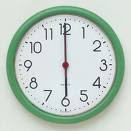 "But ma'am, it's five minutes to six. There ought to be shuttle leaving in five minutes." Then I added emphatically, as if such a thing would convince her where nothing else would, "We have to get to Boston." Surely she could understand that! Still, it was stupid of me to say such a thing. Of course we had to get to Boston. Otherwise, what on earth were we doing freezing our asses off at 6:00 a.m. EFDT** at Manchester Airport talking about the shuttle's departure times south toward, um, Boston? (** Denotes exactly what you just thought of.)
"That can't be right," Hilda declared. "I do the drive, then I have a one-hour wait in Manchester. I don't just wait five or ten minutes."
The San Diego-bound man was only too pleased to let me do all the talking and convincing. That way I would be the one to look like a jackass, and he would be just some innocent passenger. So I continued, "The schedule says that the shuttle leaves at six o'clock. The legal time right now is six o'clock." Pause. "Um, the clocks moved forward last night..."
Our new friend Hilda looked thunderstruck. "Hmm...maybe that's why my meal break at 2:00 was all messed up. Let me make a call. Maybe another shuttle is coming." She invited us in to sit down - warmer in the bus than outdoors - while she dialed someone in the know.
There was no other shuttle coming. Hilda was obliged to get back on schedule. She asked if we were heading for Anderson Square (the shuttle's first stop), or Sullivan Square (the shuttle's southernmost stop in Boston). The six of us, along with San Diego Guy (actually he was from Manchester, but we'll call him San Diego Guy) were all going to Logan. We therefore wanted a free ride as far into Boston as possible. "I don't go to Logan Airport," Hilda had explained while we were all still shivering outside, but we knew that - we had done our homework. We wanted a lift to Sullivan Square. "Okay," she announced, "since there's no stop at Anderson, we'll have a quicker trip. Would anyone mind if we left in ten or fifteen minutes instead of right now, six o'clock?" No one minded. Hilda was certainly entitled to a quick break to take a powder and grab a sandwich.
In due course we were on the road. I watched our route. Around the airport parking garage, then back out to - wait, no! This isn't happening. "The back way", only in reverse order. When we got to Rockingham Road and turned right, my disbelief was raised a notch. We were heading for Interstate 93, all right, and to get there we were passing right in front of the Sleep Inn hotel where we had just spent two nights. Double the nausea, just for the privilege of seeing "the back way" to the airport. Twice.
Once on the freeway, my sense of relief increased. Two modes of transport of the several we had planned were in the "on time and meeting expectations" column. The kids were enjoying the trip, bouncing high when we hit a bump (the effect is much greater when you sit way in the back, which two of the kiddies did), while their parents and San Diego Guy looked out into the darkness. At least we were getting closer to Logan.
 We arrived at Sullivan Square as the sun was coming up. It didn't appear to be the most attractive place in town, despite its classy name, and it didn't look like it was in the best neighbourhood, but it had a subway station, and that's all that mattered. We had completed two transportation modes now, and we needed to tackle the third. At this particular hour of the day, there were very few people around, which was probably just as well. A crowd would have made me nervous. We trudged inside, up the stairs and entered the station, hauling luggage and bags and food with us. Once inside, we were met with turnstiles and a couple of funny-looking machines that sold CharlieCards. The T was nothing if not technologically advanced, at least when it came to paying for one's transit. We stopped and stared at the machines.
 Our blank stares must have worked, because almost immediately a female employee arrived in the area and offered help. She informed us that the kids travelled free, and it was only Marie and I that needed to pay fare. Cash was $2.00 apiece, but a CharlieCard (basically an encrypted smart card) would save us 30 cents each. So we fed the machine at this good lady's instruction, and she waved a card in front of a reader, and the card was loaded with the grand total of $3.40 - enough for two adult one-way trips on the T. When she was done, San Diego Guy asked, "Uh, could you do that again?" We waited for him inside the turnstiles, and then we descended the stairs to the subway platform.
The kiddies were bursting with anticipation. A train! One that travelled outdoors and indoors! They had ridden the subway in Washington, D.C. back in March 2003, but the memories were faint. This was a new adventure! We waited patiently, shivering in the morning chill and keeping the kids back from edge of the platform. Before long, the train was in, and we were on our south on the Orange Line.
At State Station, we disembarked and began the trudge through the tunnels to the Blue Line. The tunnels reminded one of a coal mine. Once at the Blue Line platform of State Station, we waited.
During our wait we had the chance to look at approximately 100-year-old bricks which covered all surfaces on the walls, arches, and every bit overhead. They looked the way you would expect 100-year-old bricks to look - like they might all come tumbling down any second. Fortunately I had my attention taken off the bricks by the arrival of other subway travellers, some of whom looked like they hadn't slept in three days or changed clothes in three months. Despite the rough looks, everyone was harmless.
A sign on the wall described the legislation (at the state level) in 1897 that set in motion the construction of the subway system in Boston. The State station was among the older ones, and another nearby sign apologized for the look of the place and promised renovations sometime soon. Pretty interesting, really, and not a place that will forgotten anytime soon.
We travelled on the Blue line train a few stations on a northeasterly track, and got off the train at Airport station. Which, as mentioned earlier, isn't at the airport. We dutifully followed more signs and then, in the company of about one hundred other travellers, crammed onto the promised waiting transit bus via the rear door. Three down, one to go.
The kids managed to find seats, but the bus quickly filled. Once we got to the point where the chassis was in danger of snapping under the weight of the passengers, we were moving. We hadn't been going ten seconds when I did a count of our bags. One there with Veronica, one on my shoulder, one with Marie, and one with... uh... where is the other bag?
"Marie, who has the other bag?"
"Charlotte had a bag with her," came the answer. But Charlotte, sitting in the back row next to the port side windows and with her face in a book or a brochure or something, had no bag.
"Charlotte!" I hissed.
"Huh?"
"Where's the bag you had with you?"
"What?" Never, ever interrupt Charlotte's reading without being prepared for some transition time back to reality.
"The bag, Charlotte! Where is it? You had a bag with you!"
"I put it on the rack up there, Dad." Charlotte indicated a luggage rack opposite the rear door of the bus, and her manner was one of complete unconcern. She seemed surprised that such things would cause me worry. Between where I was standing, at the back of the bus a couple of feet ahead of the last row, and the luggage rack were approximately 25 people. There would be no possibility of moving up to the rack to check. But San Diego Guy had somehow overheard the whole thing, and he was standing near the rack. Through the crowd, he pointed at the rack and nodded. One more scare out of the way.
 After just a few minutes on the bus, we were in front of the terminal. The doors opened, the passengers poured out. We went with the flow, with me grabbing the stray bag off the rack as I went by, and we trudged toward the doors into the massive complex known as General Edward Lawrence Logan International Airport.
I cannot describe the relief I felt as we entered the building. We had somehow made it to the damn airport, and we were only out of pocket the sum of $3.40 - the cost to ride the T. We still had all our kids and all our bags and I had most of my sanity. All that was left was to check in, go through security, find our gate and wait for our flight. Piece of cake! Right?
We checked in at InContinent's counter and obtained our boarding passes, and then headed for the first security station. The nice lady in uniform working for the Department of Homeland Security frowned at our boarding passes.
"Your airline has flagged you for additional security checks," she said, rolling her eyes into the next time zone. We shook our heads and laughed. What else could we do? I assume the additional security checks are assigned somewhat randomly, but perhaps our change of itinerary due to the previous day's cancellations had something to do with it as well.
The good folks at the baggage scanner and metal detector stations were incredulous. "Huh? A family of six? What the -- ?" I have come to the conclusion that much of the security added to airports since 9/11 is only meant to put on a show: it reassures travellers that security is tight, and it dissuades would-be troublemakers. So once we had put all our stuff on the belt - four carry-on suitcases (we checked no bags), an opaque plastic grocery bag with fruit in it, several jackets, and tray after tray of belts, change, wallets, keys, and - don't forget! - shoes, our line was closed temporarily and travellers behind us were sent to other checkpoints. The word got around among the airport security people that we had been flagged - which meant pat-downs for all of us and hand-searching of our bags - and the disbelief continued. "What?" shouted a tall, young African-American man working with the crew. "We have to check all of THIS?" He gestured dramatically with his hand at the long line of bags, trays and jackets on the belt. Oh yeah. So they set to work.
I must say I was impressed with the professional way they went about their work and their manner of explaining their procedures. It took a few minutes, but we got through. The only thing that bothered me was something we realized after we were cleared and had gathered all of our stuff together for our trek to our gate. Inside the bag of fruit that I mentioned above was a metal serated knife for cutting grapefruit. Marie had placed it in the bag that morning and forgotten it was there, and during the security check of our bags, Homeland Security completely missed it on both the x-ray machine and in the hand-search. Hard to believe. In a sense, I had no problem with it, because, in my humble opinion, Homeland Security should be looking for terrorists, not cutlery that can be used as a weapon. This is the approach used in Israel. But that's not Homeland Security's approach. They look for weapons and dangerous materials; interviews with passengers are not part of the process. They should have confiscated that knife, and they didn't.
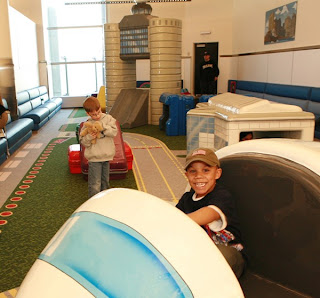 Logan Airport is huge. We found our gate and settled down to wait for our flight, leaving in about an hour and a quarter. Charlotte had done some checking of the airport's signs and announced that she knew where a kids' playpark - called a Kidport at Logan - was located. Three of the kiddies wanted to go. Fine, I said. You can go - just stay together, and in particular, watch Paul. Um, where is this park, I asked? "It's next to gate A18," Charlotte announced, and then they were off, running.
I checked my watch. We weren't squeezed for time, but knowing how way leads on to way, as Robert Frost once wrote, I figured I should find the "Kidport" and warn Charlotte to watch the clock. I left the waiting area at our gate and looked up at the signs to find Gate A18.
There was no Gate A18 in the building.
A check of the signage a little further away revealed that Gate A18 was, in fact, located in the Satellite Building of Terminal A. To get there, one had to descend a long escalator (or stairway) and go through a tunnel, which ran under a sizeable section of the tarmac. Aaauughh! Thanks for leaving that little detail out, Charlotte. So I advised Marie and Veronica of my errand to another terminal, and hurried away. When I got there, about five minutes later (after travelling very quickly on the moving sidewalks in the tunnel), I found our three play park kiddies, enjoying themselves. Charlotte seemed not to understand why it would have been important to tell me that they were travelling to another concourse by themselves, but I got my message across to her to watch the clock. After ten more minutes, they were to start making their way back.
As I was scooting back along the moving sidewalk in the tunnel, I spotted Marie running at top step toward me. Veronica was not with her - she was minding our bags and other items back by our gate.
"Jeff!" Marie was out of breath. "They're asking for volunteers to give up their seats - the plane's overbooked - they're offering compensation - what do you think?"
I admit that my first instinct was to say to hell with all that, we've been delayed enough. But as we walked back to the gate, I thought about it a little more. And Marie was convincing, too. "Three hundred dollars each," she emphasized. Well, maybe. Let's head to the gate to ask. For her part, Marie was worried that volunteers had already come forward and that we would be destined to leave on our scheduled flight to Newark.
At the gate, I learned that InContinent Airlines was indeed still overbooked and still looking for volunteers to give up their seats. I informed the lady behind the desk, a jovial, outgoing African-American woman who was handling about a hundred things at once with an impressive, calm competence and good humour, that we would be willing to take a later flight to Newark/Liberty. My idea was to get to Newark a couple of hours later, but in time to catch our flight to Tampa at about 2 p.m. - basically, just shortening our long scheduled layover in Jersey. Amid the clamour of surly passengers, she asked me to remain close by and she would call me back to the counter when she had a minute.
I broke the news to Marie, who considered it a happy thing. Fingers were crossed. Heck, they were offering compensation. After being delayed a full day, what was a couple of more hours?
Shortly I was summoned back to the gate again. It was a go - but we would not be able to catch a flight to Newark prior to our second flight leaving for Tampa. We would still fly through Newark/Liberty, but arrive in Tampa around 7:30 p.m., instead of 5:00 p.m. Would that be okay?
"Why, yes. Just fine," I told the nice lady, whom we'll call Betty. So she booked us on the later flights, and then told me it would take some time to get the boarding passes and vouchers together for us. No problem - time was plentiful now. The crowd around the gate was getting restless again - no one was much interested in getting bumped, and they were hoping that some sucker such as myself would let them leave at 9:30. So in due course, they were pleased about the turn of events.
Charlotte appeared with Camille and Paul, fresh from the Kidport, expecting to board an airplane. We explained to the kids that we would be staying in Boston for a few more hours, and at first they grumbled, but they understood it wasn't making a big difference in our arrival time in Florida, so they went along. Before long Betty called me back to the counter to hand me our new boarding passes for both flights (a total of 12), along with $1,800 in vouchers for future use with InContinent Airlines (woo-hoo!), and - a nice touch I wasn't expecting - $48 in vouchers for use at any restaurant in any airport in the United States. So we wouldn't starve while waiting.
Waiting around in an airport for a flight usually sucks, but if you ever have to choose between a long wait at Logan and a long wait at Liberty, choose Logan, especially if you're travelling with children. There's more space, more natural light (at least in Terminal A), less crowding, and better play parks for the kiddies. On this particular day, we were given the choice between the two, and since I don't much care for Newark Liberty Airport, we were quite content to wait in Boston. The only negative thought that really interfered with the day was the realization that if we had kept driving on Friday, instead of stopping in Manchester to begin the hotel-and-air-travel saga, that we would have arrived in Florida sometime on Sunday afternoon or evening - the same time we would be landing in Tampa. But look at the bright side - at least we missed all that stress we would have had on I-95, right?
At lunch we headed to Wendy's to buy some chow. We bought combos for everyone, which we usually don't do, and the bill came to $34.09 - of which $32 was covered by vouchers from Betty. Ain't nothing better than free (or nearly free) stuff. I could write about 1,500 words describing my visit to Wendy's, which I found highly entertaining, but I'll summarize it by saying that the place had good employees, bad ones, and funny ones; the customers were American, Canadian and Japanese, among others; some were quiet, some were brash and funny, and others were impatient and surly. It was grand!
Finally after our luncheon feast we were called to board the aircraft. I hadn't looked carefully at the boarding passes, so when we handed them to the lady at the gate, she looked at them and surprised us by saying, "Oh, you're going to enjoy this. Betty has put you in First Class on your flight to Newark." Betty should be running the entire airline.
 After we got settled in our spacious leather seats, with enough leg room to accommodate even tall mutants like Your Working Boy, the stewardess started offering everyone drinks. I had a glass of white wine, as did Marie, and the kiddies had juice and Sprite even before the door was shut. The passengers who were relegated to Economy Class were still boarding the aircraft, and we were settled in comfortably, drinking! Ha ha ha!! I must say, though, that I thought it rather impertinent of them to be looking at us with such envy, as you might expect from these philistines that fly Economy Class. Such a disgrace.
"Take a good look, kids," I announced, "because you'll probably not see us in First Class ever again." No doubt the others in our section, who probably had accurately identified us as displaced Economy Class philistines, were relieved to hear of the transient nature of our situation.
When a second drink was offered, I accepted, of course.
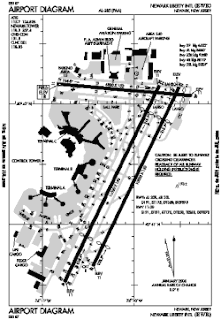 The approach into Newark was annoying for its characteristic serpentine path, speeding up, slowing down, descending, reclimbing, redescending, twisting this way and that to get into position to land. But it was a beautiful bright day, and out the left side of the plane we had an absolutely incredible view of Manhattan, close enough that we could see several landmark buildings, including the Chrysler Building and the Empire State Building, and then further south, a great view of the Statue of Liberty.
Once in the airport in Newark, we identified three objectives: 1) find our gate; 2) call the, uh, good folks at SpendThrifty and report that we would be arriving around 8 p.m. in Tampa instead of 5:30; and 3) buy some ice cream, using the remainder of our food vouchers from Betty, the smartest and nicest person working for any airline. The first item was easily checked off the list, but I had great fear when it came time to place the call to take care of the second. This was amplified when I was placed on hold, and then my call was cut off. I called back and was put on hold for approximately ten minutes. Finally a Live Person - mercifully, not Martina - took my call. I explained our situation.
"Sir, our computers are functioning very slowly today. I am going to make the change, but I ask you to please be patient as I have to put you on hold for a while until the computer confirms your later arrival." At least this SpendThrifty call-centre being seemed to have things together. And after the initial wait to have my call answered, the two minutes or so that I waited for confirmation didn't seem so bad.
Two things checked off the list. Now to the ice cream.
 Now, six ice cream cones shouldn't cost an arm and a leg, but this is an airport. In Jersey. When you travel to places as great as Liberty International Airport, you should be prepared to pay. (Actually, there are some cool things about the airport in Newark: one can fly non-stop on InContinent Airlines to Hong Kong, Beijing and New Delhi, and on Singapore Airlines non-stop to the cane-whacking capital of southeast Asia.) So the bill for our ice cream came to about $17 - somewhat expensive, really - but $16 of it was covered by vouchers. From Betty. Dang, but life is good sometimes.
We were back in Economy Class, no doubt where we belonged, for our flight to Tampa. Grateful was our clan to have an uneventful flight and to land on time in Florida.
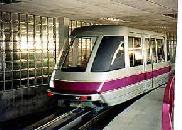 The airports in Tampa and Orlando are always a lot of fun for the kids, because after you disembark the plane, elevated trains take you from the departure/arrival terminal to the main building. You cross over tarmac, roads, palm trees, and parking lots. Even this past-40 dude finds it a total gas.
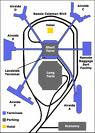 The good thing about Tampa Airport is that your rental car is waiting at the airport - just across the street from the terminal. In Orlando, you have to find a shuttle - the right one, not just any shuttle (just ask Sporko) - to take you to the rental car company lot off-site somewhere. The other thing we like about Tampa Airport is that it's just 45 miles from our place in Spring Hill, whereas landing in Orlando entails a two-hour drive across State Route 50.
So we trudged across the street to the SpendThrifty Rent-a-Chrysler counter. At this point I went through the usual ritual of producing the driver's license, the credit card, and the ever-constant confirmation number, and then the guy behind the counter - we'll call him Shifty - printed off the contract.
 "Okay, Mr. Pig, your Dodge Grand Caravan is ready upstairs, and I need you to sign here, here, and here, and initial here, here, here, here, and here."
"Right."
"And I'd like to draw your attention to this section, right here. This has to do with insurance. If you accept our insurance, you are fully covered. If you get in an accident, all you have to do is hand us the keys, and that's it," Shifty rambled.
"How much is the coverage?" I asked, knowing the answer in advance.
"Only twenty-three ninety-five a day!" yelled Shifty.
"No, thank you. My credit card has a collision damage waiver feature on it, and my auto insurance at home provides me with liability coverage," I said.
"Liability coverage isn't even required in Florida!" advised Shifty.
"Whatever. I have it anyway."
"But you don't have Loss of Use coverage," warned Shifty.
"I'm sorry?"
"Loss of Use coverage. If you get in an accident, your credit card company would pay for the damage to the car. But it wouldn't cover loss of use."
"Loss of use?" I asked incredulously. I could tell where this was going but I still couldn't believe my ears.
"Yeah, loss of use. While the car is in the shop, getting repaired, we leave your rental contract open. You'd be paying forty-nine, ninety-five a day while the car is in the shop. It's the rental fee. The car might need two, three months to get repaired." Shifty felt all this was normal and natural.
I felt otherwise. "You have got to be kidding."
"No, sir. The contract stays open. And ---"
"That's enough, please. I don't want your coverage. Where do I sign to decline it?" The insurance cost would have been more than the price of the rental!
"Right here, Mr. Pig."
With that done, I took the very strange looking car keys and collected my family for the trudge to the elevators. We made our way to Level 5, found the car, loaded our stuff and the kiddies, and settled in to check the instrument panel before starting the car. After a couple of minutes, I put the key in the ignition. It didn't fit. Nothing would turn. I tried this way, that way, with pressure in one direction then in the other. Nothing. The key was loose - it didn't seem to be made for this car or ignition type at all.
Finally I had no choice but to leave everyone in the car, run across Level 5, get on the elevator back to the street level, and make my way back to SpendThrifty's counter. I arrived out of breath and out of patience. Shifty was waiting for me.
"Problem, sir?"
"Yeah. How on earth is this key supposed to work? It doesn't fit."
 "Oh," laughed Shifty. "That's the key for the doors only. This - " he held the black tag with the remote door lock buttons on it - "is the key. This end with the red stripe fits in the ignition." (The remote door lock buttons were inoperative, by the way.)
This is both the stupidest key ever made - a chunk of plastic with a small metal end on it, containing, I assume, a radio signal to instruct the car to start - and very lousy service from SpendThrifty. Surely to Okeechobee I could have been given a 10-second instruction on the keys from Shifty when I signed my contract and declined my gold-plated insurance.
Back on the elevator, I met several other travellers. Everyone was grumbling about the "hard-sell" they got at their respective car rental counters, replete with similar scare tactics about Loss of Use costs and insurance. Everyone had declined the additional, costly insurance. One of the people in the elevator informed us that he had worked for many years in the insurance business, and he believed that most of the insurance offered by car rental companies was completely unnecessary. My take on it was that if it were not unnecessary, it was at least borderline illegal. By what sort of twisted logic does a car rental company think it ought to have the right to leave a car rental contract open while a damaged vehicle gets fixed? This situation is ripe for complications and underhandedness. The car rental company could drag its feet or collude with the collision repair shop to take extra time, with the effect that the contracts are left open longer than necessary, hitting the clients for extra charges. The potential would be very high for lawsuits - from the clients against the companies. If this sort of shit is actually legal in Florida, or anywhere else, then legislation ought to be passed to ban it. The term of the contract is the term of the contract, whether the vehicle is returned intact or flattened. What wankers. If the car rental companies need to make more money, then let them be above-board about it and charge higher rental rates. I would at least understand - times are tough. Trying to maximize revenue through unethical tactics like this (expensive insurance and open-ended contracts) only serves to make the consumer angry and less likely to do business with these idiots in the future. My brother Phil, who arrived in Florida around the same time as we did (flew into Orlando from Halifax via LaGuardia), also rented from SpendThrifty, and also got the hard sell and lousy service. Several days after getting home from our trip, I received an e-mail from SpendThrifty asking me to complete an on-line survey. I completed it, all right.
The drive to Spring Hill was great, by the way. And that's how we got to Florida.
-------------------
 And the stay in Florida was great, too. We (Ignatius, Sporkless, Phil and our American sister Laura) tried to visit to the wildlife park in Homosassa Springs, but the rain was falling. So we just returned to Spring Hill to hang out in our living room, with a few lively games of chess, some conversation, and catching-up time. The kiddies were able to head outside from time to time and play in the carport, and late in the afternoon things even cleared up enough for them to run off some energy in the backyard. (Note how the oldest of the brothers in the photo actually looks to be the youngest of the brothers.)

 On Saturday, March 15th, we took over Laura's house. The cops came, of course, but as is always good news after a party, no charges were laid. And although the swimming pool was chilly, by the standards of these wimpy Floridians (actually, by any standards - I just like taking shots at others), everyone still enjoyed the swimming. And the water fights. And the wave cave. And the pool canoe, which somehow survived all 194 pounds of Uncle Phil; the photo of this incident I have withheld from publication in the interests of good taste. Camille and Paul are rather more age appropriate.
 In this photo to the left, our host, Auntie Laura, enjoys a drink (although she has cleverly hidden it from the camera) at poolside with our stepfather Mike and Your Working Boy. This was early in the day, prior to most of the destruction. I think the trouble started when there was a lull in the conversation, and Laura, in the process of opening a beer, looked around and asked, "Shall we get wasted?"
If for some reason we get invited back next year, I'm sure all such loose talk will be verboten.
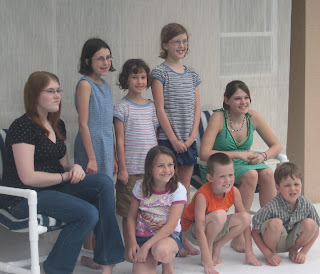 All eight grandchildren present (all of Mom's, but not Mike's) posed for a photo. The two older girls in the chairs, flanking the others, are Sporkless' stepdaughters, Megan and Melissa. Our three girls are standing in the back, and Paulo (the youngest of the group) is at the lower right, next to Laura's kiddies, Jenna and Chris.
 On Sunday, March 16th, we got together at Howard Park, in Tarpon Springs. Alas, no photos were taken of the event, which is too bad because the beach was fogged in when we arrived, but then things cleared up nicely. The fog remained just offshore, for an interesting effect. Late in the day, after Sporko and his crew had left, and Laura and her kiddies had left with Phil, the six of us went out for dinner at a fine Greek restaurant in Tarpon Springs. I say fine because the food was excellent and the bill was reasonable. We stopped outside this place just before choosing another place to eat - sorry, Costa. I know, I look stunned with my eyes nearly shut, but I assure you that's due to an unrelated alcohol problem, and the four rascals in the photo make up for it.
 On Monday, March 17th, the Cerdo family visited a new (to us) beach - Honeymoon Island, just off the coast at Palm Harbor. It's a fair trek south on US 19, not in terms of distance but rather in time, with all the traffic and intersections and stops and starts, but it's well worth the trip. (It's about 15 minutes north of Clearwater Beach, if that helps.) Most of the island is actually a state park. We started the day with a trip to the beach, where the queen of my heart posed for a fine photo. After that, we adjourned to the picnic area for lunch, where we just missed seeing a huge rattlesnake cross the roadway. Apparently the snake crossed behind our car, and the folks following us, travelling from Virginia, were quite thrilled about the sighting and told me about it when we parked.
 After that, we started on a walk on the trails in the woods on the north end of the island. The information officer at the interpretation centre told us that we would be unlikely to see a rattlesnake, especially since they prefer being in full sun, but we were on our guard anyway. Camille posed for a terrific photo just as we were getting underway.
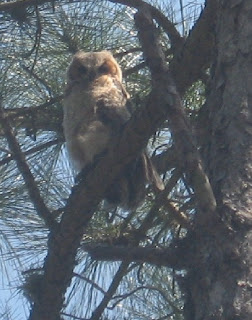 We saw no snakes, but there were lots of interesting birds. Lots of cranes and ospreys. The ospreys build these huge, ostentatious nests in the tops of dead trees, probably with the help of subprime loans. They'll be sorry once the housing market bubble collapses in their neck of the woods. One of the most interesting sights was a great horned owl, watching people walk by on the trail. It is the only time I have ever seen an owl in the wild.
 On Tuesday, March 18th, having some beach ambition still not used up, we visited Pine Island Beach in Hernando County, which is only about 15 minutes' drive from our place in Spring Hill. It was a bit of a low note, though - the wind was pretty strong on the beach, and there were warning signs about high bacteria content in the water, so no one dared swim or wade in water deeper than over the knees. Paul was undeterred, and set to work on reshaping the beach with an artificial dune.
We flew back to Manchester on Friday, March 21st, via Cleveland, which rocks. A fine night of sleep was had in Milford, Maine, right on the Penobscot River, and we crossed back into Canada the following day with $4 US in our possession. (Not kidding.) A flat tire outside Petitcodiac, New Brunswick, slowed us down at bit, but by afternoon we were back in our driveway. Great to get away, and great to get home again.
Thus endeth my documentary. Tune in six months from now, when I describe next month's trip to Quebec.


